
Av Comercial






S!
La angustia de un fallo de motor.
Nen
Piloto
La angustia de un fallo de motor.
La angustia de un fallo de motor.
Siempre hay uno de los planos entra en perdida antes que el otro de ahi que se inclinara antes del impacto yendo tan justo de velocidad como parece que iba.
Last edited by Nen hace 11 años, edited 1 time in total.
v1T1
Piloto
La angustia de un fallo de motor.
La angustia de un fallo de motor.
Definitivamente..., 2015 será el año con más muertos en su principio..., al menos que yo recuerde..
Vaya rachita macho..
A ver si se para de una vez.
Vaya rachita macho..
A ver si se para de una vez.
Ruso
Invitado
La angustia de un fallo de motor.
La angustia de un fallo de motor.
Estaba dudando donde ponerlo :oops: pero como obedece directamente a aviación civil y no entraría en el ya extinto foro de "la cagada del día" lo comparto aquí :mrgreen:
Furia
Piloto
Patrocinador
La angustia de un fallo de motor.
La angustia de un fallo de motor.
Lo que es llamativo es la velodicad y la "intensidad" de caida del ala. A esa velocidad eso es producido por llevar un motor parado y el otro a tope,
En las imagenes no se aprecia bien pero si se observa que el algulo de paso de las palas de la helice del motor izquierdo era muy abierto, posiblemente la helice estaba abanderada.
En el ATR el motor izquierdo es precisamente el motor "critico"
Segun ha declarado la autoridades de Taiwan, el piloto realizo 3 llamadas de mayday y anuncio un "engine flameout"
En un bimotor de helice si bajas de la velocidad de Vmca y tienes el motor bueno a tope de empuje pasa esto
http://youtu.be/YqmomTUVsAw
Lo que no se entiende es que aun en caso de tener un fallo en el motor izquierdo, y sin ir cargado a tope, el avion no pudiese continuar su ascenso y mantener una velocidad adecuada.
Hay algunas teorias ya circulando en los foros especializados que creo que van por el buen camino pero prefiero de momento no especular mas.
En las imagenes no se aprecia bien pero si se observa que el algulo de paso de las palas de la helice del motor izquierdo era muy abierto, posiblemente la helice estaba abanderada.
En el ATR el motor izquierdo es precisamente el motor "critico"
Segun ha declarado la autoridades de Taiwan, el piloto realizo 3 llamadas de mayday y anuncio un "engine flameout"
En un bimotor de helice si bajas de la velocidad de Vmca y tienes el motor bueno a tope de empuje pasa esto
http://youtu.be/YqmomTUVsAw
Lo que no se entiende es que aun en caso de tener un fallo en el motor izquierdo, y sin ir cargado a tope, el avion no pudiese continuar su ascenso y mantener una velocidad adecuada.
Hay algunas teorias ya circulando en los foros especializados que creo que van por el buen camino pero prefiero de momento no especular mas.
Jazz
Instructor
La angustia de un fallo de motor.
La angustia de un fallo de motor.
Lo del la caída de plano, es como dice Furia porque van más lento que la "Vmca". Según los reportes declararon emergencia a ATC por un "flameout" en un motor.
Vmca es la velocidad mínima de control (en condiciones más desfavorables)
Por debajo de cierta velocidad, no tienes suficiente recorrido en el rudder para compensar el torque del otro motor que funciona. Generalmente suele estar por encima de la velocidad de pérdida. Aunque Vmca, no es fija y depende de varios factores. De la configuración, el peso, el empuje del motor que funciona... etc. Puede darse el caso de que Vmca esté por debajo de la pérdida a partir de ciertas altitudes de densidad.
Lo curioso es que en el video el avión aparece en descenso y con una actitud parecida a la pérdida. Y el final efectivamente sea el hachazo final por querer tirar de la palanca para librar el puente...
Fotos del rescate de los supervivientes. Parece increíble que no hayan muerto todos. :shock:

SpoilerYa se verá en la investigación pero ahí va mi cosecha propia:
No sería la primera vez que a un bimotor le falla un motor y abanderan el bueno. :oops: Y este tiene muchos números de que sea así.
Y el segundo factor. Las tripulaciones asiáticas tienen por lo general un entrenamiento muy deficiente. Lo he visto en españoles que han ido a hacer horas allí (pagándoselas) y lo han visto amigos míos que están volando en compañías aéreas del Golfo Pérsico.
Vmca es la velocidad mínima de control (en condiciones más desfavorables)
Por debajo de cierta velocidad, no tienes suficiente recorrido en el rudder para compensar el torque del otro motor que funciona. Generalmente suele estar por encima de la velocidad de pérdida. Aunque Vmca, no es fija y depende de varios factores. De la configuración, el peso, el empuje del motor que funciona... etc. Puede darse el caso de que Vmca esté por debajo de la pérdida a partir de ciertas altitudes de densidad.
Lo curioso es que en el video el avión aparece en descenso y con una actitud parecida a la pérdida. Y el final efectivamente sea el hachazo final por querer tirar de la palanca para librar el puente...
Fotos del rescate de los supervivientes. Parece increíble que no hayan muerto todos. :shock:
SpoilerYa se verá en la investigación pero ahí va mi cosecha propia:
No sería la primera vez que a un bimotor le falla un motor y abanderan el bueno. :oops: Y este tiene muchos números de que sea así.
Y el segundo factor. Las tripulaciones asiáticas tienen por lo general un entrenamiento muy deficiente. Lo he visto en españoles que han ido a hacer horas allí (pagándoselas) y lo han visto amigos míos que están volando en compañías aéreas del Golfo Pérsico.
v1T1
Piloto
La angustia de un fallo de motor.
La angustia de un fallo de motor.
Mega LoL :DRuso Estaba dudando donde ponerlo :oops: pero como obedece directamente a aviación civil y no entraría en el ya extinto foro de "la cagada del día" lo comparto aquí :mrgreen:
Jazz
Instructor
La angustia de un fallo de motor.
La angustia de un fallo de motor.
Al final mis sospechas se han confirmado. Falló el motor 2 a 1200' AGL y abanderaron el motor 1... :oops:
Fuente Aviation Herald:
Lo de apagar el motor bueno en un caso de fallo o fuego de motor es algo que ocurre más habitualmente de lo que nos pensamos. Como instructor de multi engine en USA lo veía muchas veces. Ante una situación de estrés la mano se equivoca. Y es muy importante dedicar un par de segundos a lo que esta pasando antes de tomar acción. En aviones mono tripulados la regla de pie muerto - motor muerto te puede salvar de esto. En aviones politripulados hay que confirmar a viva voz con el compañero antes de apagar, cortar y tirar de un extintor.
Desafortunadamente, como también dije, el entrenamiento en los países asiáticos es bastante deficiente. Demasiado cuadriculado y con poco sentido común. Al final el piloto héroe, ha pasado a demonio en un segundo y lo han pagado 35 personas con su vida. :| :cry:
Fuente Aviation Herald:
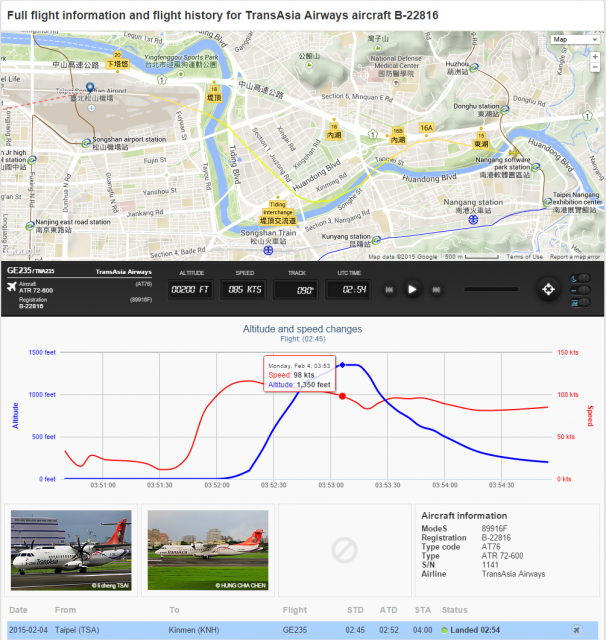
Eso explica porque iba en descenso con una actitud de morro tan pronunciada. No tenían empuje. Y por tanto el hachazo final es debido a que entran en pérdida.A Transasia Avions de Transport Regional ATR-72-212A, registration B-22816 performing flight GE-235 from Taipei Songshan to Kinmen (Taiwan) with 53 passengers and 5 crew, departed Songshan's runway 10. Shortly after takeoff at 10:52L (02:52Z) the aircraft began to roll left, the crew radioed "Mayday! Mayday! Engine Flame Out!" at 10:53L with no further transmission, the aircraft reached a maximum height of about 1500 feet (corrected for QNH), lost height, struck a taxi, hit a Huangdong Boulevard Viaduct with its left wing at nearly 90 degrees of bank angle at about 10:54L (02:54Z) and impacted the water of the Keelung River near the Nankang Software Park coming to rest inverted, about 2.9nm from the end of runway 10. 15 people were rescued alive, 35 occupants were killed, 8 people are missing and feared trapped inside the remaining wreckage submerged in the river. 2 occupants of the taxi were taken to a hospital with minor injuries.
The airline reported at 23:00L that 26 occupants have been killed, 14 occupants are being treated in various hospitals, one survivor has already been released from hospital care. The accident ATR-72-600 has been in service for less than a year and underwent last regular maintenance on Jan 26th 2015. The airline conducts an immediate inspection of all engines on their fleet following a directive by Taiwan's Civil Aviation Authority.
On Feb 5th 2015 the airline reported that the two pilots at the controls had 4,914 hours and 6,922 hours total flying experience, an instructor with 16,121 hours total occupied the observer's seat. The crew had signed the flight papers, that showed no unusual circumstances. 31 occupants are confirmed dead, 15 occupants were taken to hospitals, 14 remain in hospital care, one was discharged already, 12 occupants are missing, 2 injured on the ground are still in hospital treatment, too. The examination of the entire ATR fleet under surveillance by Taiwan's Civil Aviation Authority has been completed.
On Feb 6th 2015 the airline reported that so far 35 bodies have been recovered, 30 of which have been identified. In response to media misreporting the airline re-stated, that the pilot in the left hand seat had 4,914 hours of total experience, in the right hand seat 6,922 hours total experience and the instructor on the observer's seat 16,121 hours total experience.
Taiwan's ASC have dispatched investigators on site and opened an investigation. The French BEA representing the state of manufacture dispatched two investigators to Taiwan, the Canadian TSB representing the state of engine manufacture (PW127) dispatched an accredited representative to Taiwan.
On Feb 5th 2015 Taiwan's ASC reported that the black boxes have been received in the evening of Feb 4th, the CVR contains 4 tracks of high quality recordings for 150 minutes, the flight data recorder recording 750 parameters has also been downloaded, analysis of the data has already begun currently synchronising the recordings. Various investigation groups started their tasks to collect evidence on site, e.g. in cooperation with criminal police to establish the first point of impact, establish instrument panel readings, collecting witness statements, obtain maintenance documents, collect ATC recordings and statements, collect weather information. Investigators by BEA and ATR have already arrived, investigators from the Canadian TSB are expected to arrive during Feb 5th.
On Feb 6th 2015 Taiwan's ASC reported that the investigation so far determined from flight data and cockpit voice recorders: the aircraft received takeoff clearance at 10:51Z, in the initial climb the aircraft was handed off to departure at 10:52:33Z. At 10:52:38Z at about 1200 feet MSL, 37 seconds after becoming airborne, a master warning activated related to the failure of the right hand engine, at 10:52:43Z the left hand engine was throttled back and at 10:53:00Z the crew began to discuss engine #1 had stalled. At 10:53:06Z the right hand engine (engine #2) auto-feathered. At 10:53:12Z a first stall warning occured and ceased at 10:53:18Z. At 10:53:19Z the crew discussed that engine #1 had already feathered, the fuel supply had already been cut to the engine and decided to attempt a restart of engine #1. Two seconds later another stall warning activated. At 10:53:34Z the crew radioed "Mayday! Mayday! Engine flame out!", multiple attempts to restart the engines followed to no avail. At 10:54:34Z a second master warning activated, 0.4 seconds later both recorders stopped recording.
Metars:
RCSS 040400Z 10009KT 9999 FEW009 BKN025 BKN035 16/13 Q1023 NOSIG RMK A3023
RCSS 040330Z 11011KT 9999 FEW015 BKN025 BKN035 16/13 Q1024 NOSIG RMK A3024
RCSS 040307Z 11010KT 9999 FEW015 BKN028 BKN040 16/13 Q1024 NOSIG RMK A3024
RCSS 040300Z 10010KT 9999 FEW015 BKN028 BKN040 16/13 Q1024 NOSIG RMK A3025
RCSS 040230Z 10008KT 9999 FEW013 BKN028 BKN040 16/13 Q1024 NOSIG RMK A3025
RCSS 040225Z 10008KT 9999 FEW013 BKN028 BKN040 16/13 Q1024 NOSIG RMK A3026
RCSS 040200Z 11007KT 9999 -DZ FEW013 BKN028 BKN040 16/14 Q1024 NOSIG RMK A3026
RCSS 040130Z 11008KT 9999 -DZ FEW013 BKN028 BKN040 16/13 Q1025 NOSIG RMK A3027
RCSS 040100Z 11007KT 9999 -DZ FEW009 BKN028 BKN040 16/13 Q1024 NOSIG RMK A3026
Lo de apagar el motor bueno en un caso de fallo o fuego de motor es algo que ocurre más habitualmente de lo que nos pensamos. Como instructor de multi engine en USA lo veía muchas veces. Ante una situación de estrés la mano se equivoca. Y es muy importante dedicar un par de segundos a lo que esta pasando antes de tomar acción. En aviones mono tripulados la regla de pie muerto - motor muerto te puede salvar de esto. En aviones politripulados hay que confirmar a viva voz con el compañero antes de apagar, cortar y tirar de un extintor.
Desafortunadamente, como también dije, el entrenamiento en los países asiáticos es bastante deficiente. Demasiado cuadriculado y con poco sentido común. Al final el piloto héroe, ha pasado a demonio en un segundo y lo han pagado 35 personas con su vida. :| :cry:
ManOWar
Invitado
La angustia de un fallo de motor.
La angustia de un fallo de motor.
:mrgreen: :mrgreen: Es muy bueno, pero ese vídeo lo conocía hace bastante, así que esa información de "ha pasado hace unos días" para nada. Y dice que es Pilas pero el original que conocía era en Cádiz, y el acento del tío para mí que efectivamente es de allí.v1T1Mega LoL :DRuso Estaba dudando donde ponerlo :oops: pero como obedece directamente a aviación civil y no entraría en el ya extinto foro de "la cagada del día" lo comparto aquí :mrgreen:
S!
Furia
Piloto
Patrocinador
La angustia de un fallo de motor.
La angustia de un fallo de motor.
Si el tema de la identificacion incorrecta del motor que falla a la hora de apilcar los procedimientos es un recurrente.
A nosotros en los entrenamientos nos lo meten hasta en la sopa y aun asi hay gente que a veces se equivoca si se dejan llevar por la presion por lo que el entrenamiento es fundamental.
Si no recuerdo mal en España hubo un accidente con Binter en Melilla donde también hubo una confusión similar de motores en el procedimiento.
LINK ARTICULO
En Asia valoran mucho las horas de vuelo pero no las de simulador y puedes tener 20000 horas de vuelo y si no has tenido nunca ninguna emergencia y no las has entrenado, cuando te toca, estas peor preparado para salir de ella que un chaval de 1000 horas pero con 50 de simulador (de emergencias)
Los accidentes evitables son los mas tristes de todos. :cry:
A nosotros en los entrenamientos nos lo meten hasta en la sopa y aun asi hay gente que a veces se equivoca si se dejan llevar por la presion por lo que el entrenamiento es fundamental.
Si no recuerdo mal en España hubo un accidente con Binter en Melilla donde también hubo una confusión similar de motores en el procedimiento.
LINK ARTICULO
En Asia valoran mucho las horas de vuelo pero no las de simulador y puedes tener 20000 horas de vuelo y si no has tenido nunca ninguna emergencia y no las has entrenado, cuando te toca, estas peor preparado para salir de ella que un chaval de 1000 horas pero con 50 de simulador (de emergencias)
Los accidentes evitables son los mas tristes de todos. :cry:
Jazz
Instructor
La angustia de un fallo de motor.
La angustia de un fallo de motor.
Un poco más sobre las estelas turbulentas. :?
A esta C-172 le pilló en corta final la estela de un DHC-8 Dash 8. Por suerte el piloto reaccionó a tiempo y... llevaba una mamá Cessna.
https://www.youtube.com/watch?v=BuGFIXxkyLU#t=485
Luego aparece un "near miss" en el área de prácticas. Hay tanta gente ahí que es normal encontrarse a un "invasor inesperado". En este caso un estudiante que volaba solo y que mantenía toda su atención en el avión. Es por ello que se suelen usar frecuencias de UNICOM para dar reportes de posición y separarse unos de otros. Aún así las colisiones ocurren.. :|
A esta C-172 le pilló en corta final la estela de un DHC-8 Dash 8. Por suerte el piloto reaccionó a tiempo y... llevaba una mamá Cessna.
https://www.youtube.com/watch?v=BuGFIXxkyLU#t=485
Luego aparece un "near miss" en el área de prácticas. Hay tanta gente ahí que es normal encontrarse a un "invasor inesperado". En este caso un estudiante que volaba solo y que mantenía toda su atención en el avión. Es por ello que se suelen usar frecuencias de UNICOM para dar reportes de posición y separarse unos de otros. Aún así las colisiones ocurren.. :|
No registered users